Meta incremental attribution: the 2026 guide to real ROI
Is your ROAS fake? Meta's 2026 Incremental Attribution reveals the truth. Learn how to filter out organic noise and measure real lift.

Imagine your Ads Manager shows 100 conversions. It looks like a success, until you realize that 30 of those customers were already on your email list or had searched for your brand name on Google. They would have bought anyway.
This "noise" is the primary reason why Meta incremental attribution has become the gold standard for media buyers in 2026. As Meta officially restricts traditional 7-day view and 28-day view windows on January 12, 2026, the platform is shifting away from simple correlation toward causation.
Meta incremental attribution isn’t just a new reporting column, it is a fundamental shift in how we prove the value of every dollar spent.
how meta incremental attribution works
Standard tracking is a bit like a sports team taking 100% of the credit for a win, even if the other team didn’t show up. If a customer sees your ad and then buys something, Meta claims the sale. But as a business owner, you know that some of those people were probably going to buy from you anyway, maybe they saw your sign on the street, got an email from you, or are simply loyal fans.
Meta incremental attribution is designed to filter out that "noise." It asks one simple question: "Did this person buy because of the ad, or would they have bought without it?"
To answer this, Meta uses its vast history of data to predict two types of customers:
The "genuinely influenced" customer: Someone who wasn’t thinking about buying until your ad appeared and nudged them to take action.
The "already decided" customer: Someone who was already on their way to your website and just happened to scroll past your ad on the way.
Instead of just showing your ads to anyone likely to buy, the incremental attribution model tells the algorithm to go after the first group. It ignores the "easy wins" that would have happened for free and focuses your budget on the customers you actually need to convince.
In short, it’s the difference between paying for a sale you already had and paying to grow your business with a customer you didn’t have yet.
why 2026 is the year of incremental thinking
For years, digital marketing has been plagued by over-attribution. High-intent users, particularly in retargeting audiences, often get credited to ads despite being at the finish line. This creates a skewed reality where performance looks great on paper while actual business growth remains stagnant.
In 2026, Meta incremental attribution solves this by providing a hard reset on how we measure ROI. You finally stop overpaying for organic conversions that Meta previously claimed through standard view-through windows. The system isolates the specific uplift created by your campaigns so every euro is tied to a transaction that would not have happened otherwise.
Strategic budget allocation also becomes much more precise. This model reveals exactly when a campaign has reached a point of diminishing returns. If increasing your spend does not increase your incremental lift, it is a clear signal that you are merely paying for people who were already likely to convert.
Finally, this approach brings needed cross-channel clarity. By isolating Meta’s specific impact, you can see how it works alongside Google Search and TikTok without double-counting sales. This independent verification allows for a more harmonious strategy across your entire digital ecosystem.
key benchmarks and features in 2026
The 2026 update to the Ads Manager interface has made Meta Incremental Attribution more accessible than ever. New features include:
Real-time lift reporting: you no longer need to run a 30-day "Lift Study". Incremental data is now integrated into standard reporting columns.
GDPval integration: Meta now benchmarks your incremental performance against industry averages to show if your brand is growing faster than your competitors.
Predictive modeling: the system uses digital intelligence to predict which creative assets will drive the highest lift before you spend a single euro.
how to activate meta incremental attribution
There are two distinct ways to use this technology. You can optimize for it to change who sees your ads, or you can use it for reporting to simply see the truth behind your current numbers.
activating incremental optimization
Use this method when you want Meta’s AI to stop finding "easy" conversions (like people already in your funnel) and focus on finding people who only convert because they saw your ad.
Level: Ad Set Level
Step 1: Create or edit a campaign with a sales or leads objective.
Step 2: At the ad set level, scroll down to the optimization & delivery section.
Step 3: Click on "show more options" underneath your performance goal.
Step 4: Find attribution setting and select incremental attribution.
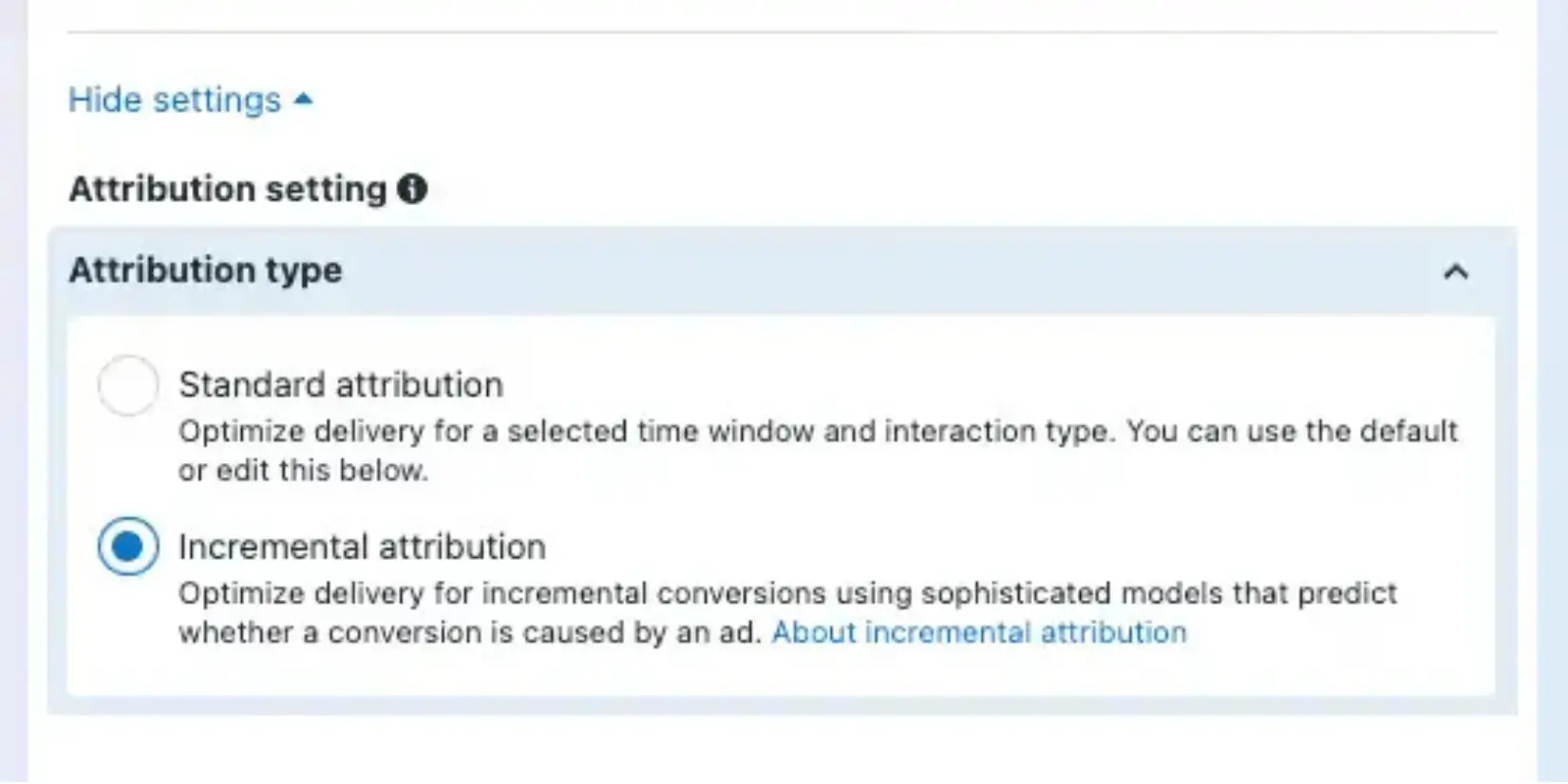
Pro Tip: When you activate this, you might see fewer reported conversions initially. Don’t panic—the algorithm is simply filtering out the "noise" and focusing on higher-quality, net-new growth.
activating incremental reporting
You can view incremental data for any active or past campaign without changing its settings. This is perfect for auditing your Meta lookalike audiences to see if they are driving real value.
Level: Ads manager reporting table
Step 1: In your main table, click the columns dropdown menu.
Step 2: Select compare attribution settings (found at the bottom).
Step 3: In the side panel that appears, look under the advanced or additional settings section and check the box for incremental attribution.
Step 4: Click apply.
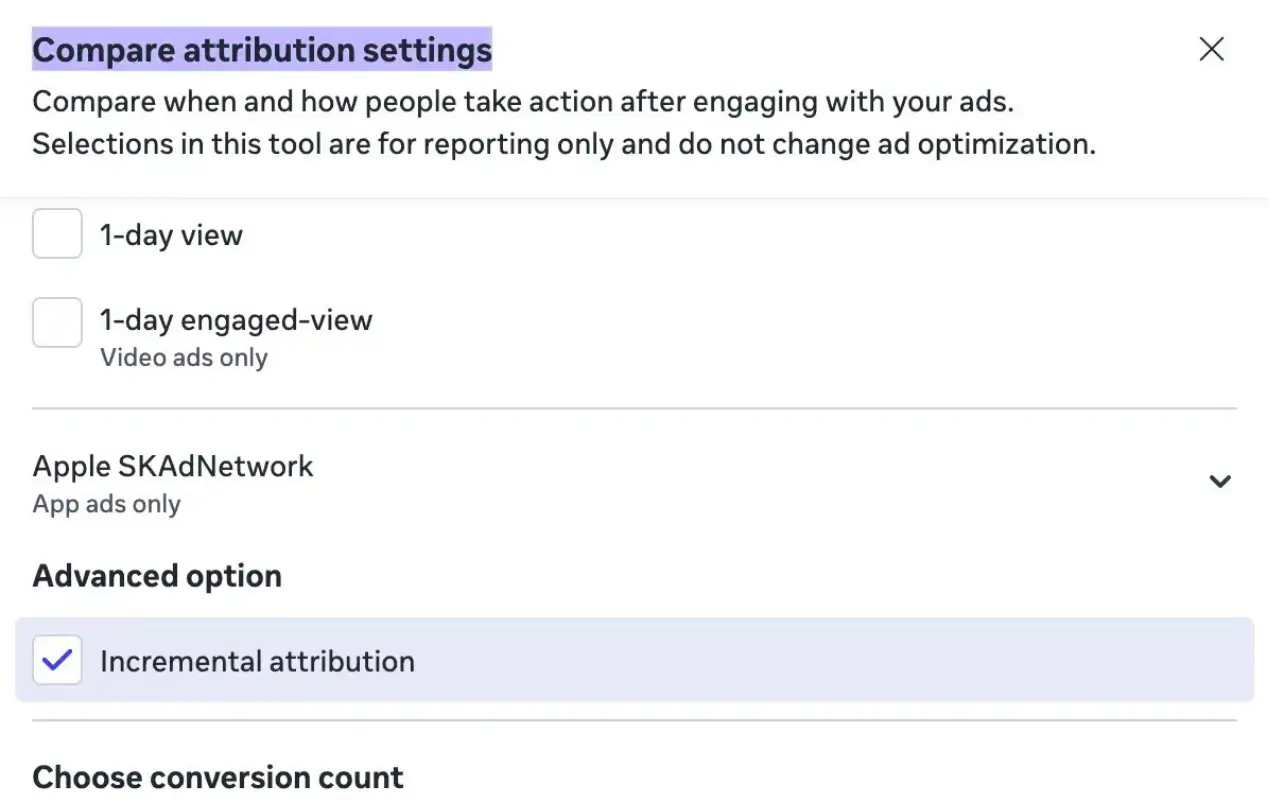
what happens after activation? Once reporting is active, your table will display new columns:
Incremental conversions: the estimated number of sales that happened only because of your ads.
Incremental ROAS: your "True Return," excluding organic sales.
The result? You can finally see the gap between "what Meta claims" and "what actually moves the needle." If the gap is small, your strategy is efficient. If the gap is huge, it’s time to rethink your retargeting spend.
the bottom line
As we move through 2026, the brands that thrive won’t be the ones with the highest "reported" ROAS, but the ones with the highest incremental lift. Transitioning to Meta Incremental Attribution allows you to:
Isolate true growth: distinguish between customers who were "going to buy anyway" and those truly won by your creative strategy.
Optimize for profit: shift your budget away from saturated retargeting loops and into high-impact, top-of-funnel acquisition.
Future-proof your data: stay ahead of privacy-driven shifts by using Meta’s native causal modeling rather than outdated tracking pixels alone.
Understanding the math behind your ads is the difference between scaling a brand and simply burning a budget. At pansyer, we partner with AdMax to deliver performance marketing strategies that go beyond the basic Ads Manager dashboard.
We help brands navigate the 2026 landscape by implementing Meta incremental attribution audits and value-based scaling models that focus on your bottom line, not just vanity metrics. If you’re ready to see the true impact of your ad spend, contact us today.

Code is just a tool. Тhe goal is growth.
Imagine your Ads Manager shows 100 conversions. It looks like a success, until you realize that 30 of those customers were already on your email list or had searched for your brand name on Google. They would have bought anyway.
This "noise" is the primary reason why Meta incremental attribution has become the gold standard for media buyers in 2026. As Meta officially restricts traditional 7-day view and 28-day view windows on January 12, 2026, the platform is shifting away from simple correlation toward causation.
Meta incremental attribution isn’t just a new reporting column, it is a fundamental shift in how we prove the value of every dollar spent.
how meta incremental attribution works
Standard tracking is a bit like a sports team taking 100% of the credit for a win, even if the other team didn’t show up. If a customer sees your ad and then buys something, Meta claims the sale. But as a business owner, you know that some of those people were probably going to buy from you anyway, maybe they saw your sign on the street, got an email from you, or are simply loyal fans.
Meta incremental attribution is designed to filter out that "noise." It asks one simple question: "Did this person buy because of the ad, or would they have bought without it?"
To answer this, Meta uses its vast history of data to predict two types of customers:
The "genuinely influenced" customer: Someone who wasn’t thinking about buying until your ad appeared and nudged them to take action.
The "already decided" customer: Someone who was already on their way to your website and just happened to scroll past your ad on the way.
Instead of just showing your ads to anyone likely to buy, the incremental attribution model tells the algorithm to go after the first group. It ignores the "easy wins" that would have happened for free and focuses your budget on the customers you actually need to convince.
In short, it’s the difference between paying for a sale you already had and paying to grow your business with a customer you didn’t have yet.
why 2026 is the year of incremental thinking
For years, digital marketing has been plagued by over-attribution. High-intent users, particularly in retargeting audiences, often get credited to ads despite being at the finish line. This creates a skewed reality where performance looks great on paper while actual business growth remains stagnant.
In 2026, Meta incremental attribution solves this by providing a hard reset on how we measure ROI. You finally stop overpaying for organic conversions that Meta previously claimed through standard view-through windows. The system isolates the specific uplift created by your campaigns so every euro is tied to a transaction that would not have happened otherwise.
Strategic budget allocation also becomes much more precise. This model reveals exactly when a campaign has reached a point of diminishing returns. If increasing your spend does not increase your incremental lift, it is a clear signal that you are merely paying for people who were already likely to convert.
Finally, this approach brings needed cross-channel clarity. By isolating Meta’s specific impact, you can see how it works alongside Google Search and TikTok without double-counting sales. This independent verification allows for a more harmonious strategy across your entire digital ecosystem.
key benchmarks and features in 2026
The 2026 update to the Ads Manager interface has made Meta Incremental Attribution more accessible than ever. New features include:
Real-time lift reporting: you no longer need to run a 30-day "Lift Study". Incremental data is now integrated into standard reporting columns.
GDPval integration: Meta now benchmarks your incremental performance against industry averages to show if your brand is growing faster than your competitors.
Predictive modeling: the system uses digital intelligence to predict which creative assets will drive the highest lift before you spend a single euro.
how to activate meta incremental attribution
There are two distinct ways to use this technology. You can optimize for it to change who sees your ads, or you can use it for reporting to simply see the truth behind your current numbers.
activating incremental optimization
Use this method when you want Meta’s AI to stop finding "easy" conversions (like people already in your funnel) and focus on finding people who only convert because they saw your ad.
Level: Ad Set Level
Step 1: Create or edit a campaign with a sales or leads objective.
Step 2: At the ad set level, scroll down to the optimization & delivery section.
Step 3: Click on "show more options" underneath your performance goal.
Step 4: Find attribution setting and select incremental attribution.
Pro Tip: When you activate this, you might see fewer reported conversions initially. Don’t panic—the algorithm is simply filtering out the "noise" and focusing on higher-quality, net-new growth.
activating incremental reporting
You can view incremental data for any active or past campaign without changing its settings. This is perfect for auditing your Meta lookalike audiences to see if they are driving real value.
Level: Ads manager reporting table
Step 1: In your main table, click the columns dropdown menu.
Step 2: Select compare attribution settings (found at the bottom).
Step 3: In the side panel that appears, look under the advanced or additional settings section and check the box for incremental attribution.
Step 4: Click apply.
what happens after activation? Once reporting is active, your table will display new columns:
Incremental conversions: the estimated number of sales that happened only because of your ads.
Incremental ROAS: your "True Return," excluding organic sales.
The result? You can finally see the gap between "what Meta claims" and "what actually moves the needle." If the gap is small, your strategy is efficient. If the gap is huge, it’s time to rethink your retargeting spend.
the bottom line
As we move through 2026, the brands that thrive won’t be the ones with the highest "reported" ROAS, but the ones with the highest incremental lift. Transitioning to Meta Incremental Attribution allows you to:
Isolate true growth: distinguish between customers who were "going to buy anyway" and those truly won by your creative strategy.
Optimize for profit: shift your budget away from saturated retargeting loops and into high-impact, top-of-funnel acquisition.
Future-proof your data: stay ahead of privacy-driven shifts by using Meta’s native causal modeling rather than outdated tracking pixels alone.
Understanding the math behind your ads is the difference between scaling a brand and simply burning a budget. At pansyer, we partner with AdMax to deliver performance marketing strategies that go beyond the basic Ads Manager dashboard.
We help brands navigate the 2026 landscape by implementing Meta incremental attribution audits and value-based scaling models that focus on your bottom line, not just vanity metrics. If you’re ready to see the true impact of your ad spend, contact us today.
Code is just a tool. Тhe goal is growth.
Imagine your Ads Manager shows 100 conversions. It looks like a success, until you realize that 30 of those customers were already on your email list or had searched for your brand name on Google. They would have bought anyway.
This "noise" is the primary reason why Meta incremental attribution has become the gold standard for media buyers in 2026. As Meta officially restricts traditional 7-day view and 28-day view windows on January 12, 2026, the platform is shifting away from simple correlation toward causation.
Meta incremental attribution isn’t just a new reporting column, it is a fundamental shift in how we prove the value of every dollar spent.
how meta incremental attribution works
Standard tracking is a bit like a sports team taking 100% of the credit for a win, even if the other team didn’t show up. If a customer sees your ad and then buys something, Meta claims the sale. But as a business owner, you know that some of those people were probably going to buy from you anyway, maybe they saw your sign on the street, got an email from you, or are simply loyal fans.
Meta incremental attribution is designed to filter out that "noise." It asks one simple question: "Did this person buy because of the ad, or would they have bought without it?"
To answer this, Meta uses its vast history of data to predict two types of customers:
The "genuinely influenced" customer: Someone who wasn’t thinking about buying until your ad appeared and nudged them to take action.
The "already decided" customer: Someone who was already on their way to your website and just happened to scroll past your ad on the way.
Instead of just showing your ads to anyone likely to buy, the incremental attribution model tells the algorithm to go after the first group. It ignores the "easy wins" that would have happened for free and focuses your budget on the customers you actually need to convince.
In short, it’s the difference between paying for a sale you already had and paying to grow your business with a customer you didn’t have yet.
why 2026 is the year of incremental thinking
For years, digital marketing has been plagued by over-attribution. High-intent users, particularly in retargeting audiences, often get credited to ads despite being at the finish line. This creates a skewed reality where performance looks great on paper while actual business growth remains stagnant.
In 2026, Meta incremental attribution solves this by providing a hard reset on how we measure ROI. You finally stop overpaying for organic conversions that Meta previously claimed through standard view-through windows. The system isolates the specific uplift created by your campaigns so every euro is tied to a transaction that would not have happened otherwise.
Strategic budget allocation also becomes much more precise. This model reveals exactly when a campaign has reached a point of diminishing returns. If increasing your spend does not increase your incremental lift, it is a clear signal that you are merely paying for people who were already likely to convert.
Finally, this approach brings needed cross-channel clarity. By isolating Meta’s specific impact, you can see how it works alongside Google Search and TikTok without double-counting sales. This independent verification allows for a more harmonious strategy across your entire digital ecosystem.
key benchmarks and features in 2026
The 2026 update to the Ads Manager interface has made Meta Incremental Attribution more accessible than ever. New features include:
Real-time lift reporting: you no longer need to run a 30-day "Lift Study". Incremental data is now integrated into standard reporting columns.
GDPval integration: Meta now benchmarks your incremental performance against industry averages to show if your brand is growing faster than your competitors.
Predictive modeling: the system uses digital intelligence to predict which creative assets will drive the highest lift before you spend a single euro.
how to activate meta incremental attribution
There are two distinct ways to use this technology. You can optimize for it to change who sees your ads, or you can use it for reporting to simply see the truth behind your current numbers.
activating incremental optimization
Use this method when you want Meta’s AI to stop finding "easy" conversions (like people already in your funnel) and focus on finding people who only convert because they saw your ad.
Level: Ad Set Level
Step 1: Create or edit a campaign with a sales or leads objective.
Step 2: At the ad set level, scroll down to the optimization & delivery section.
Step 3: Click on "show more options" underneath your performance goal.
Step 4: Find attribution setting and select incremental attribution.
Pro Tip: When you activate this, you might see fewer reported conversions initially. Don’t panic—the algorithm is simply filtering out the "noise" and focusing on higher-quality, net-new growth.
activating incremental reporting
You can view incremental data for any active or past campaign without changing its settings. This is perfect for auditing your Meta lookalike audiences to see if they are driving real value.
Level: Ads manager reporting table
Step 1: In your main table, click the columns dropdown menu.
Step 2: Select compare attribution settings (found at the bottom).
Step 3: In the side panel that appears, look under the advanced or additional settings section and check the box for incremental attribution.
Step 4: Click apply.
what happens after activation? Once reporting is active, your table will display new columns:
Incremental conversions: the estimated number of sales that happened only because of your ads.
Incremental ROAS: your "True Return," excluding organic sales.
The result? You can finally see the gap between "what Meta claims" and "what actually moves the needle." If the gap is small, your strategy is efficient. If the gap is huge, it’s time to rethink your retargeting spend.
the bottom line
As we move through 2026, the brands that thrive won’t be the ones with the highest "reported" ROAS, but the ones with the highest incremental lift. Transitioning to Meta Incremental Attribution allows you to:
Isolate true growth: distinguish between customers who were "going to buy anyway" and those truly won by your creative strategy.
Optimize for profit: shift your budget away from saturated retargeting loops and into high-impact, top-of-funnel acquisition.
Future-proof your data: stay ahead of privacy-driven shifts by using Meta’s native causal modeling rather than outdated tracking pixels alone.
Understanding the math behind your ads is the difference between scaling a brand and simply burning a budget. At pansyer, we partner with AdMax to deliver performance marketing strategies that go beyond the basic Ads Manager dashboard.
We help brands navigate the 2026 landscape by implementing Meta incremental attribution audits and value-based scaling models that focus on your bottom line, not just vanity metrics. If you’re ready to see the true impact of your ad spend, contact us today.
Code is just a tool. Тhe goal is growth.
subscribe to our
weekly
newsletter
Get curated marketing insights, expert tips, and the latest agency news delivered straight to your inbox every week. Stay ahead with us.

subscribe to our
weekly
newsletter
Get curated marketing insights, expert tips, and the latest agency news delivered straight to your inbox every week. Stay ahead with us.
subscribe to our
weekly
newsletter
Get curated marketing insights, expert tips, and the latest agency news delivered straight to your inbox every week. Stay ahead with us.